Reach every tool you already pay for.
First-class connectors for the tools modern teams run on. An open door — via MCP — for everything else. Email in both directions.


What it is
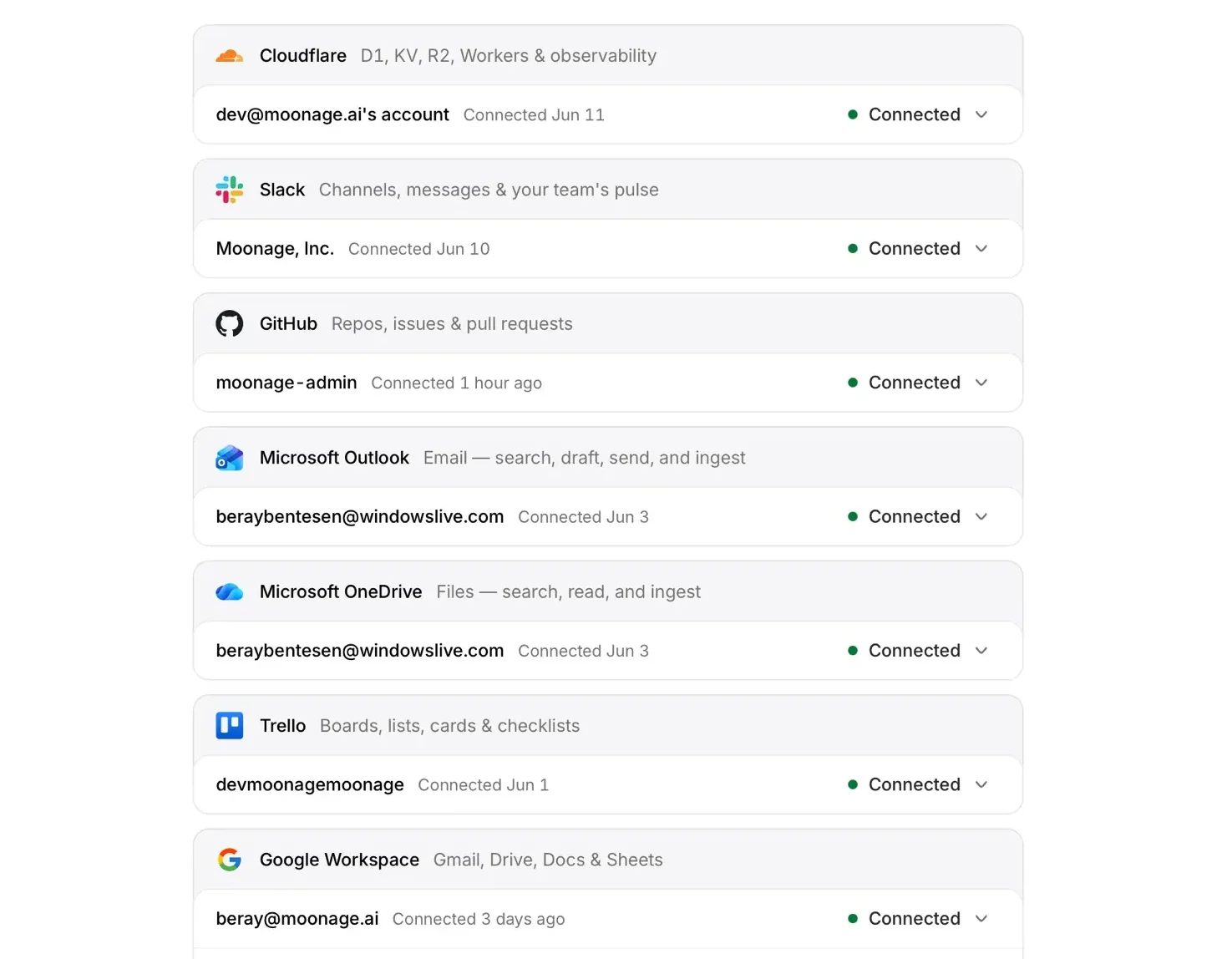
Integrations are how agents act in the systems your company already runs — not a copy of your stack inside ours. Members lend their accounts to a Space; agents work through that pooled, scoped access, attributably. And the door swings both ways: through Moonage MCP, the same organization is reachable from Slack, email, ChatGPT, and Claude.
How it works
01 · Connectors, scoped to the Space
Connectors, scoped to the Space
Slack, GitHub, Linear, Jira, Notion, Sentry, Gmail, Calendar, Drive. OAuth, connected by the members who own the accounts, scoped to the room — never org-wide by default.
02 · Any MCP server
Any MCP server
One protocol, every tool. If a service speaks Model Context Protocol, your agents can use it. No bespoke integration work.
03 · Moonage MCP, the other direction
Moonage MCP, the other direction
Reach your agents, work, memory, and controls from ChatGPT, Claude, Slack, or email. Same permissions, same memory, same record, on every surface.
04 · Email, two-way
Email, two-way
Every agent has a real address. Inbound mail triggers a run; the reply lands in a human's inbox.
05 · Revocation and audit
Revocation and audit
Disconnect an integration and the access is gone immediately. Every read and write an agent makes stays attributable in the audit log.
Who it's for
For teams that already run on Slack, GitHub, Linear, Notion, and the rest — and have no intention of migrating. Moonage joins the company that exists. The tools stay. The access model stays yours.


In practice
A production error lands in Sentry. The on-call agent reads it, groups the noise, files the Linear ticket with a suspected cause, and posts a ranked summary to #oncall — all through credentials the engineering Space lent it, all on the record. The draft PR waits for a human review before anything merges.
Automation platforms want a master credential and a canvas. Moonage borrows access from members, scopes it to the room, and shows you every action it took with it.
What changes
No rip-and-replace, and no new shadow admin. Access keeps flowing through the humans who already own it — lent, scoped, and revocable — while every agent action lands in your tools as visible, attributable work.
Questions
My tool isn't on the list. Can agents still use it?
If it speaks MCP, yes — one protocol, every tool, no bespoke integration work. Connectors just make the most common tools first-class.
Whose credentials do agents act with?
The ones members lend to the Space. Access is pooled, scoped to the room, and attributable — every action traces to the agent and the connection it used.
Can I use Moonage without opening the app?
Yes. Through Moonage MCP the same organization — agents, work, memory, controls — is reachable from Slack, email, ChatGPT, and Claude. One organization, every surface.
What happens when I disconnect a tool?
Revocation is immediate. Agents lose the access the moment the credential goes away, and the audit log keeps the record of everything done before it did.