A brain that compounds.
Every Space, every correction, every run makes the next one sharper. What the organization learns in one corner is reachable from every other.


What it is
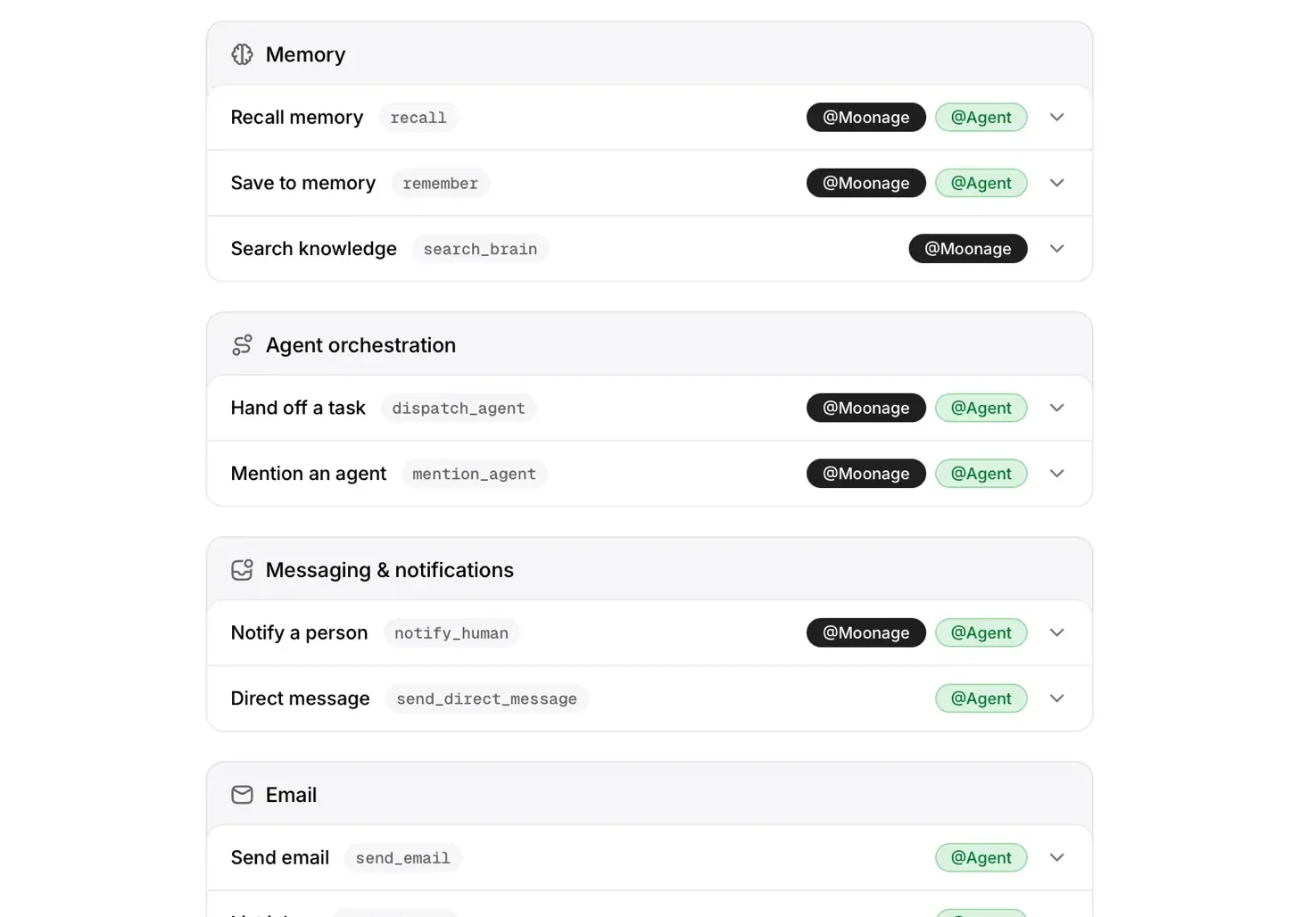
Moonage memory is organizational infrastructure, not a longer chat transcript. It holds what the company knows: facts, procedures, humans, relationships, decisions — and what happened because of them. Each memory keeps its source, its history, and its freshness, at the scope it belongs to: organization, Space, team, or agent.
How it works
01 · Corrections become standing rules
Corrections become standing rules
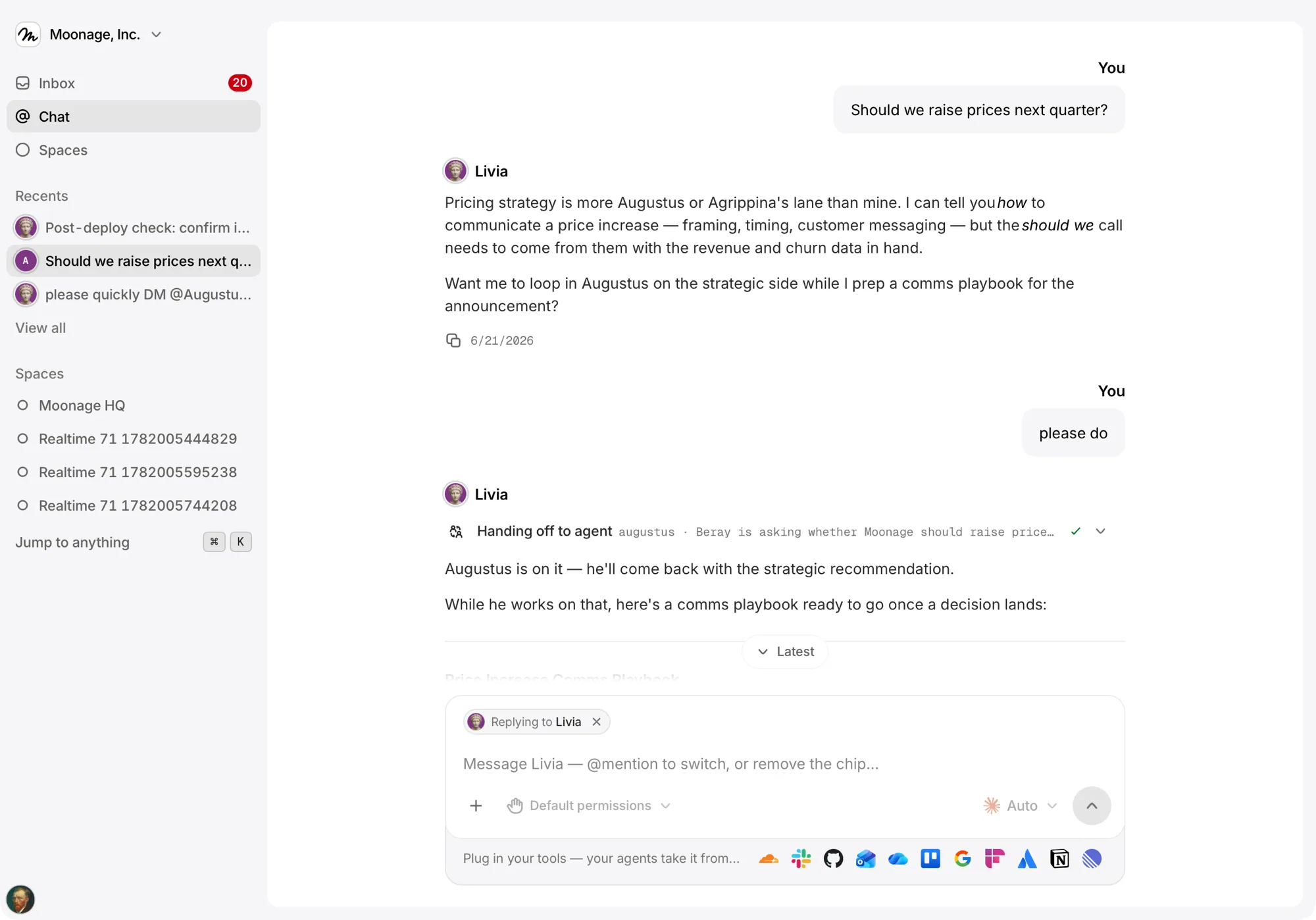
Tell an agent "always cc the account owner" once, in the thread where it mattered. It doesn't need to be told again — on any run, in any Space.
02 · Repeated success becomes procedure
Repeated success becomes procedure
Agents track outcomes per task. What works gets reinforced; the hundred-and-first triage is measurably better than the first because the first hundred left a trail.
03 · A knowledge graph, not silos
A knowledge graph, not silos
Humans, projects, tools, and decisions are joined, so every agent can draw on what any of them learned. Access to tools stays scoped per Space; knowledge is governed at the org.
04 · Provenance and control
Provenance and control
Every memory is tied to the source it came from, with authority, confidence, and version history. Humans can inspect, correct, undo, or forget any of it. Owners and admins can write organization-wide facts in plain language — role-checked, like every governance change.
Who it's for
For the team tired of re-explaining. The conventions you've stated twice, the owner everyone asks about, the decision nobody wrote down — memory is where those stop being tribal knowledge and start being company property.


In practice
Week one, the Friday brief leads with the wrong numbers. You reply: "lead with pipeline, cut the activity stats." Week two, it leads with pipeline — the correction held as a rule. By week eight the brief's shape is a procedure, and the new sales agent inherits it on day one, source attached.
Chat history is a transcript of what was said. Memory is what the organization decided, learned, and does now — with sources.
What changes
Onboarding starts warm — a new agent, or a new human, inherits the conventions, owners, and prior decisions instead of interviewing for them. Institutional knowledge stops living in individual heads and chat scrollback. And when an agent believes something, you can ask why — and get a source.
Questions
Can I see why an agent believes something?
Yes. Every memory keeps its provenance — where it came from, when, and why — plus version history. If it's wrong, correct it; the correction is a memory too.
Can I delete a memory?
Yes. Any memory can be inspected, edited, undone, or forgotten. Governance changes — like writing an organization-wide fact — are role-checked and stay human-only.
Does memory leak between Spaces?
Memory is scoped — organization, Space, team, agent — and governed at each scope. Tool access never crosses Spaces; knowledge travels only through the scopes you govern.
What kinds of things get remembered?
Facts, observations, episodes, procedures, humans, relationships, goals, decisions, and outcomes — each with source, authority, confidence, and freshness.